Accessible Cruises for Seniors: What to Know About Mobility at Sea
For a traveler who uses a cane, a walker, a scooter, or a wheelchair, a cruise can be the easiest vacation available. Your room travels with you, meals are steps away, and the ship is designed to move thousands of people smoothly. But “can be” is the operative phrase. Accessible cruises for seniors are the product of good planning, and the planning has to happen before the booking is made, not after.
This guide covers what to look for in an accessible stateroom, why the type of port matters more than most people realize, how to bring mobility equipment aboard, and how to handle medical and dietary needs so the ship is ready for you.
Accessible Staterooms: What They Offer and Why to Book Early
Accessible staterooms are built differently from standard ones. Doorways are wider, there is turning space for a wheelchair, the bathroom has a roll-in shower with a fold-down seat and grab bars, and the sink and closet rods are lowered. Some lines also offer an in-between category, sometimes called ambulatory accessible, for travelers who walk but need a step-free shower and grab bars.
Every ship has a limited number of these rooms, often a few dozen on a large ship and only a handful on a small luxury or river vessel. They are released early and booked early. If you need one, it should be the first thing confirmed, before the itinerary is finalized. Most lines also ask you to complete a form confirming the need so the rooms go to guests who require them.
Getting Around the Ship
Larger ocean ships are generally the most accessible. They have multiple banks of elevators, wide corridors, automatic doors in public areas, accessible restrooms on most decks, and pool lifts. Distances are longer, which is where a scooter earns its keep, but there are few physical barriers.
Smaller luxury ships have shorter distances but sometimes fewer elevators and narrower passages. Older ships of any size may have raised thresholds at doorways or steps into certain venues. Asking about a specific ship, not just a cruise line, is the only way to know.
Two features to ask about: whether the stateroom balcony has a raised sill or a ramp, and whether the ship’s gangways can be set level at each planned port.
Docked Ports vs. Tender Ports
This is the single most important accessibility factor in choosing an itinerary, and it is the one most often overlooked. When a ship docks, it ties up at a pier and passengers walk or roll off across a gangway. When a ship anchors offshore, passengers transfer to smaller boats called tenders to reach land.
Tendering requires stepping from the ship into a moving boat, and most cruise lines will not carry a wheelchair or scooter user onto a tender for safety reasons unless the guest can transfer independently and conditions are calm. In practice, that means a traveler with significant mobility limitations may be unable to go ashore at tender ports at all.
Before choosing an itinerary, ask which ports are docked and which are tendered. An itinerary with mostly docked ports is a far better fit than one that looks better on paper but leaves you on board three days out of seven.
Shore Excursions and Accessibility
Cruise lines label certain excursions as accessible, and those labels are worth reading carefully. “Accessible” may mean a lift-equipped motorcoach and a fully step-free route, or it may mean a tour that is simply less strenuous. The excursion description should specify the amount of walking, the surface, the number of steps, and whether a folding wheelchair can be accommodated.
Historic European towns are often the most challenging: cobblestones, hills, and cathedrals with steps at the entrance. Modern cities, waterfront promenades, scenic drives, and boat tours tend to be easier. Private accessible tours booked in advance, with a vehicle matched to your equipment, are often the most comfortable option in ports where the ship’s offerings are limited.
Bringing Mobility Equipment Aboard
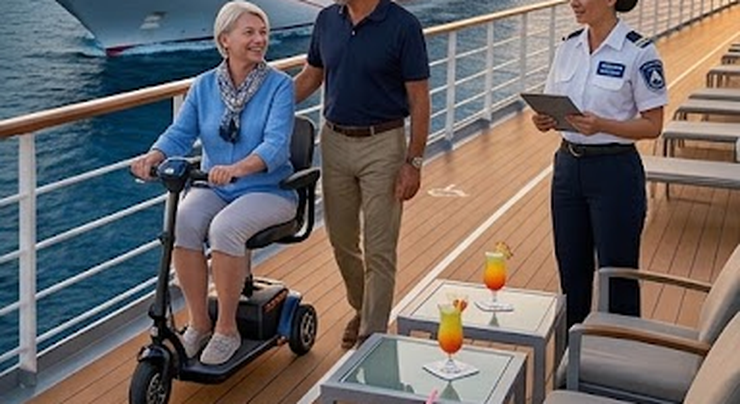
Manual wheelchairs, power wheelchairs, and mobility scooters are welcome on nearly all cruise ships, with a few conditions. The equipment must fit inside your stateroom; it cannot be stored in the corridor, which is a fire-safety rule enforced without exception. That is one reason an accessible stateroom matters even for travelers who can walk short distances: a standard cabin door is often too narrow for a scooter.
Width limits vary by ship, so confirm the maximum dimensions with the cruise line before you travel. Batteries should be the dry-cell or gel type, and you may be asked for the specifications. If you would rather not travel with your own scooter, specialty rental companies can deliver one directly to the ship and collect it at the end of the cruise.
Airlines have their own rules for transporting mobility devices, and those need to be handled separately if you are flying to the port.
Medical Needs, Oxygen, and Dietary Requirements
Every major cruise line has a special needs or accessibility department, and contacting it well before sailing is how the ship prepares for you. Portable oxygen concentrators generally require advance approval and documentation. Sharps containers, refrigerated medication storage, and extension cords for medical equipment can all be arranged if requested ahead of time.
Dietary requirements, whether medical or by preference, should be submitted in advance as well. Ships handle low-sodium, diabetic, gluten-free, and allergen-restricted meals routinely, but the galley plans from the manifest, not from a conversation on embarkation day.
Bring more medication than the trip requires, in original containers, in your carry-on rather than checked luggage, along with a written list of medications and conditions for the ship’s medical center.
River Cruising and Accessibility
River cruises deserve a specific note because they are often assumed to be easier than they are. River ships are small, which means short distances, but many have only one elevator, and it frequently does not reach the sun deck. Some older river vessels have no elevator at all. Ships also sometimes dock side by side in busy ports, requiring passengers to walk through one or more neighboring ships to reach the shore.
The towns themselves are old, with cobblestones and hills. River cruising can be a wonderful choice for a traveler who walks with a cane or manages stairs slowly, but it is a difficult fit for a full-time wheelchair user. Newer ships on some lines have improved on this, and a travel advisor can identify which ones.
How Krystal Travel Plans Accessible Cruises
Planning an accessible cruise means confirming the stateroom, checking every port, reviewing excursions, coordinating with the cruise line’s accessibility department, and arranging equipment, all before you leave home. At Krystal Travel Co. in San Antonio, this is work we do for clients over 55 every season. Call 210-826-4149, explore our cruise planning services, or get in touch and tell us what you need. We will find a ship and an itinerary that make the trip comfortable from the first day to the last. Se habla español.